By Mark McCulloch
When you look at your log home, timber siding, or custom deck, you see a major investment that defines the character of your property. You know it needs protection, but walking down the stain aisle is overwhelming. There are hundreds of cans promising the world. How do you know which one will actually last, but worst, which one will leave you scraping and sanding in two years?
At Sundance Coatings, we don’t believe in guesswork. We believe in resolving coating formulation issues before they become a reality.
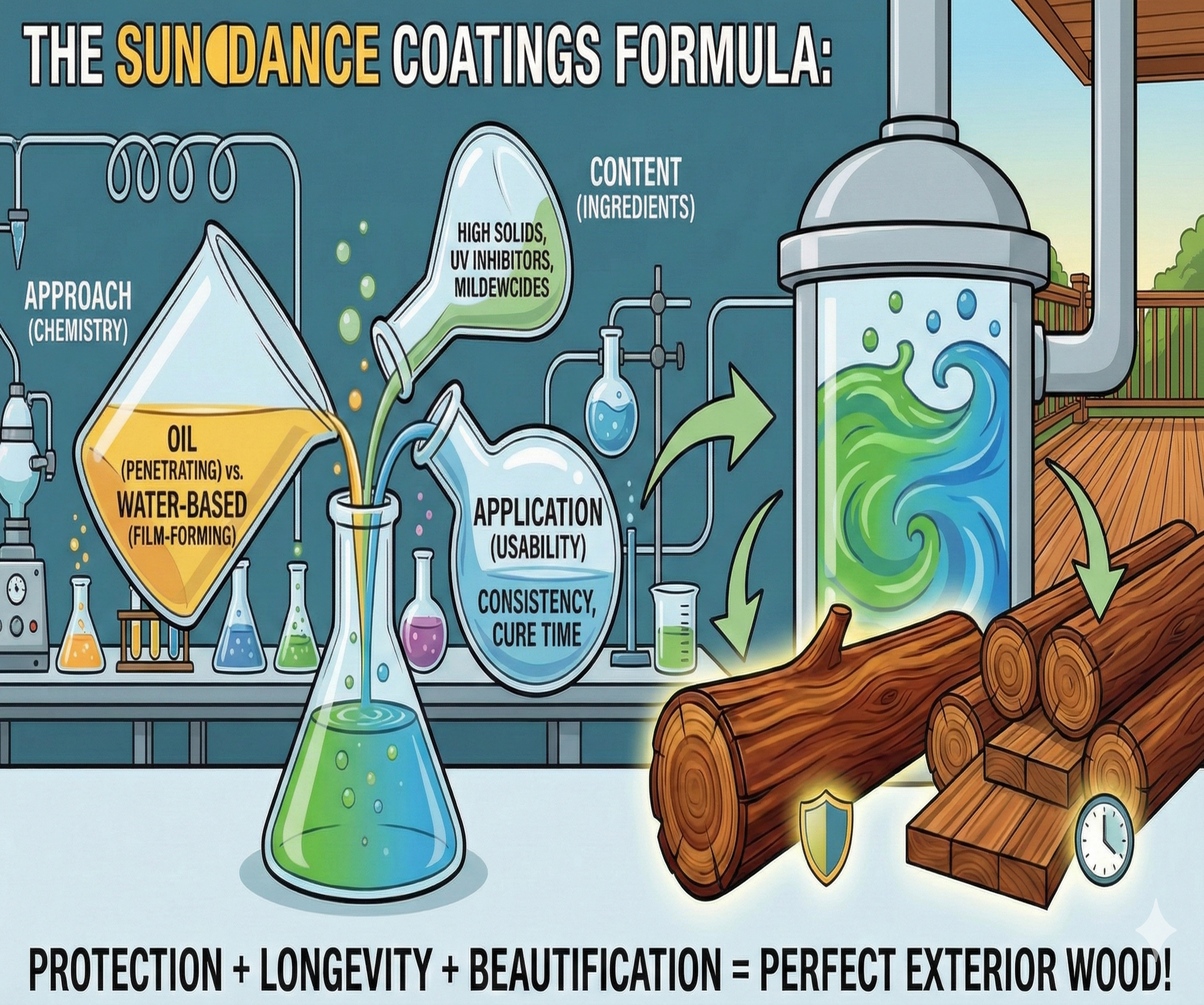
Over years of observing what fails and what works, we developed a rigorous selection process—an ‘equation’—to define the perfect exterior wood stain. We don’t just look at color; we evaluate every technical aspect of our stain sealers to ensure that when you apply them, you get the best possible outcome.
Here is the framework we use to define quality:


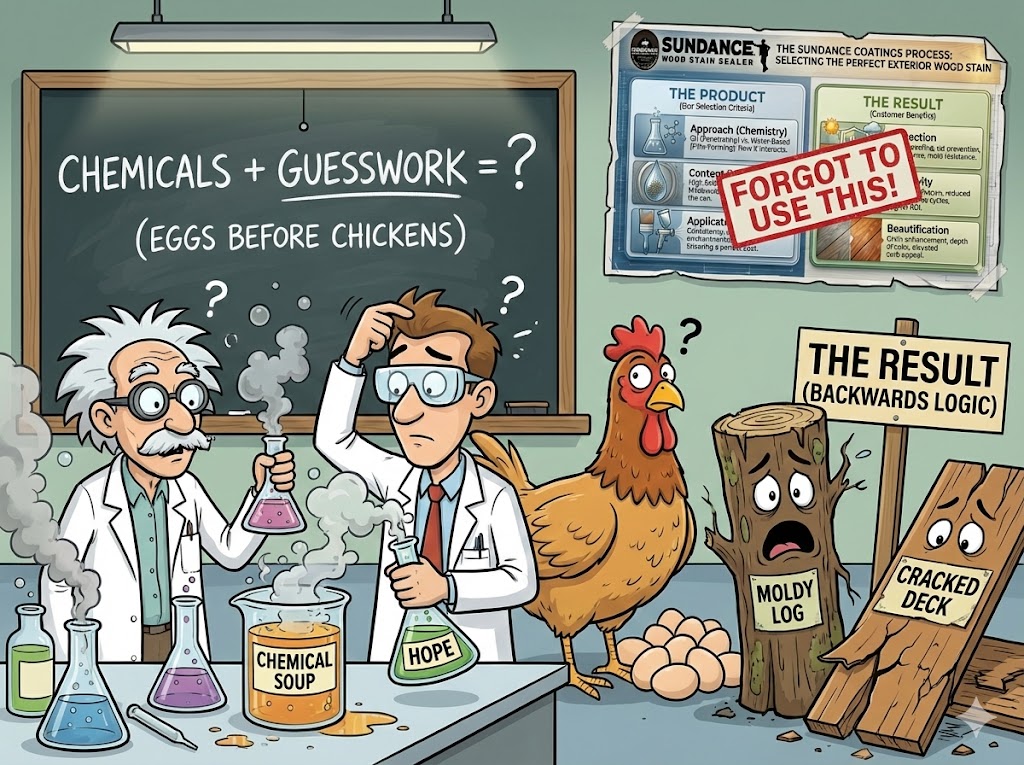
The Industry Paradox: The “Chicken Before the Egg”?
To understand why our process is different, you have to understand the sheer insanity of the current market.
Looking at the “premium” sealers on the shelf, you have to wonder: Are these companies actually designing for an outcome, or are they just mixing chemicals and hoping for the best?
It often feels like the industry is suffering from a bad case of “backward logic”—the proverbial “which came first: the chicken or the egg?” It seems competitors create a chemical soup in a lab first, then realize the consequences later. They formulate a product and only then discover, “Oops, this is going to need three coats to cover,” or “this creates a gummy mess unless you apply it wet-on-wet ,” or “this is going to need to be sanded off to reapply,” and/or this looks like S*#@!
Instead of fixing the chemistry, they just write instructions that force you to work harder. They let the limitations of their product dictate the application nightmare you have to endure.
Is there any thought as to what is actually going to have the best outcome for the wood? Sometimes, we wonder.
For decades, this backward approach has led to the widespread use of organic saturated drying oils (like linseed and tung oil). The industry keeps plugging them into formulas, ignoring the obvious drawbacks:
- They Feed Mold: They literally provide a buffet for fungus to turn your wood black.
- They Crack & Peel: They form surface films that degrade under UV light, leading to expensive blasting repairs.
- The Application is Miserable: Because the chemistry is flawed, the process is flawed—tacky finishes, lap marks, and wasted time.
At Sundance Coatings, we refused to accept this “product-first” mentality. We started with the Result—a durable, beautiful, one-coat finish—and engineered the chemistry formulation to achieve it.
The Solution: sundance’s LOG*1 COAT & DECK*1 COAt
Using the criteria in our flowchart—Approach, Content, and Application—we have defined the ideal solution:
LOG*1 COAT & DECK*1 COAT
We don’t use organic drying oils that feed mold and create soon-to-fail blotchy surface films. Instead, we utilize a unique penetrating oil blend that answers the Sundance Equation perfectly:
1. The Approach (Chemistry formulation): Penetration, Not Film
The Criterion: We needed a chemistry that interacts with the wood, not just sits on top of it. Our Solution: LOG*1 COAT & DECK*1 COAT utilize proprietary long-oil alkyd resins blended with non-drying oils. Instead of forming a surface film that can crack and peel, this unique blend penetrates deeply, filling and bulking up the porous wood fibers. It strengthens and stabilizes the wood’s structure (lignin) and repels water from the inside out, not outside in.
2. The Content (Ingredients): Low solvents/High Solids/ No Mold Food
The Criterion: What’s inside the can must actively protect the wood without harmful solvent fillers.
Our Solution: Aa low-solvent, high-solids formulation (what’s left behind after it dries).
- No Mold Food: Because we do not use organic drying oils, we remove the primary food source for black mold. We further enhance this with effective mold fungicides.
- Nano-Colorants: Our enhanced nanoparticle colorants deliver a more natural wood tone that resists yellowing, enhancing the wood’s natural beauty.
- Lower VOCs: By using high-viscosity non-drying oils, we reduce the need for solvents (VOCs <100), making it a more environmentally friendly choice that meets US regulations and has minimal odor.
- Higher Solids: Our higher solids content ensures a longer-lasting wood tone and UV protection.
The Criterion: The product must ensure a perfect coat without a miserable application process.
Our Solution: Our LOG*1 COAT & DECK*1 COAT formulations that truly change the game.
- Enhanced Durability With Just ONE Coat: Our unique formulation replenishes and strengthens wood fibers in a single application.
- Timely Drying: Our blend dries at the perfect pace. You have plenty of time to distribute a uniform finish without the worry of “wet-on-wet” application panic. It typically dries within a day without risk of being tacky.
3. The Application: The One-Coat Advantage
The Criterion: The product must ensure a perfect finish without a miserable application process.
The Sundance Resolution:
LOG*1 COAT & DECK*1 COAT are formulations that truly change the game.
- Enhanced Durability With Just ONE Coat: Our unique formulation replenishes and strengthens wood fibers in a single application.
- Stress-Free Drying: Our blend dries at the perfect pace. You have plenty of time to distribute a uniform finish without the panic of “wet-on-wet” application. It typically dries within a day without the risk of remaining tacky.
The Final Result: Resolving the Paradox
By solving the “Product” side of the equation with our advanced formulation, we deliver the “Best Answer Result” to our customers.
| Feature | LOG*1 COAT | DECK*1 COAT |
| Durability | Superior resistance to UV damage and weathering. | Tough foot-traffic protection. |
| Longevity | 5-6 years (Sun) / 7-8 years (Shade). | 2-3 years (Flat) / 5-6 years (Verticals). |
| Maintenance | No Sanding. Simple wash and recoat. | No Sanding. Simple wash and recoat. |
Don’t settle for “backward” chemistry formulations that feed mold and peel away. Choose the solution backed by the Sundance process.

