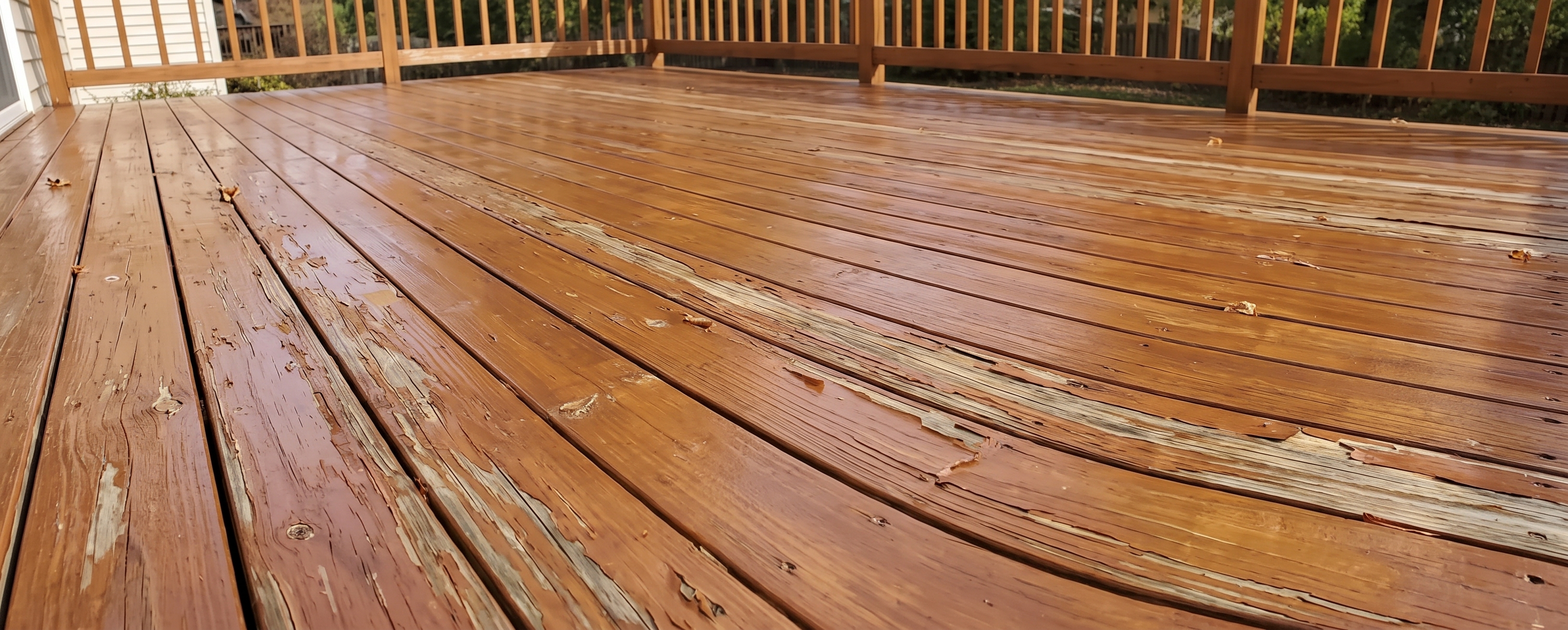
Why Traditional stains fail
How Bio-Inert Chemistry Saves Your Deck and Log Home
A log home, exterior wood deck, or timber siding structure rarely fails because wood itself is problematic. It fails because moisture, aggressive ultraviolet (UV) exposure, and unstable surface coatings work continuously from the surface inward. Traditional film-forming finishes trap water beneath a rigid skin, causing cracking, peeling, and costly chemical-stripping projects. True wood preservation—whether for logs or decks—requires protecting timber from within while allowing the grain, texture, and natural character of real lumber to remain visible.
For exterior lumber, a sealer is not just a water repellent; it is an engineered protection system addressing driving rain, standing snow, UV breakdown, dimensional wood movement, and biological growth without trapping timber beneath a brittle film. Chemistry inside the can matters far more than a vague label claim of “weatherproof protection.”
What Exterior Wood Sealers Must Accomplish
Exterior wood is inherently hygroscopic, absorbing and releasing moisture as weather fluctuates. This movement creates mechanical stress, leading to checking, cupping, splitting, raised grain, and fastener strain. A quality sealer limits liquid-water intrusion by creating a defense of resins and bio-inert oils that won’t feed mold to protect from the inside out—without creating a surface film destined to fail.
Water protection alone is insufficient. Direct sunlight delivers aggressive UV rays that break down lignin, the cellular structure binding wood fibers together. As lignin degrades, the surface turns gray, fibers loosen, and wood becomes vulnerable to moisture penetration. Clear sealers can temporarily repel water, but without robust UV defense, they cannot stop graying on exposed surfaces.
Effective exterior protection requires combining water resistance, UV defense, and deep fiber conditioning. Semi-transparent finishes are not merely decorative. Properly engineered nano-enhanced pigmentation actively screens harmful UV energy while keeping visible wood grain intact.
Penetrating Sealers vs. Surface Film Coatings
The primary divide among wood sealers is whether the product deeply penetrates the substrate or cures as a rigid film on top. Film-forming coatings build a uniform skin that looks appealing initially on smooth siding, railings, or logs. However, wood moves continuously, while a hardened surface skin lacks elasticity.
Once moisture gets beneath that film through an end grain, joint, crack, or fastener hole, the coating loses adhesion. Flaking, blistering, and peeling follow rapidly. Restoring a failed film coating requires costly chemical stripping or media blasting before applying a new finish.
Penetrating systems carry protective resins and pigments directly into wood fibers rather than building a skin overhead. They stabilize the wood’s cellular structure from within, repelling water while leaving a natural, low-sheen appearance without an artificial plastic film waiting to delaminate.
The Sundance Advantage: Bio-Inert Chemistry vs. Toxic High-Solvent Competitors
Not all penetrating stains perform equally. Competitor stain sealers commonly rely on stubborn organic resins (such as linseed or tung oil) or traditional long-oil alkyd chemistries that tend to lay on top of the wood, creating a problematic surface film. Because these heavy organic oils resist natural absorption, competitors overload their formulas with high levels of volatile, toxic solvents—such as xylene and ethylbenzene—simply to break down those oils and force penetration. Furthermore, organic resins serve as an active food source for mildew, algae, and fungal growth in damp environments.
Sundance Coatings eliminates these hazards entirely. Our formulas contain no organic resins, standard long-oil alkyds, or toxic solvent loads. Instead, we engineer our stain sealers with bio-inert modified alkyd resins and non-drying mineral oil, built on an extremely low solvent-to-high solids ratio.
- Bio-Inert Modified Alkyd Resins: Stabilize the wood’s lignin (cellular structure) to lock in pigmentation while completely denying mold or fungi a food source.
- Mineral Oil: Bulks the wood fiber internally to repel liquid water and prevent drying and checking.
- Low Solvent, High Solids: Minimal solvent is wasted on atmospheric evaporation or toxic diluents. What remains anchored inside the timber is a dense concentration of active protective solids.
Purpose-Built Protection: DECK*1 COAT & LOG*1 COAT
Different wood species and structural exposures demand tailored chemistry rather than a generic compromise:
- DECK*1 COAT: Formulated with a 90% solids ratio and just a bit more mineral spirits to ensure deep penetration into denser deck-treated pine. It delivers maximum UV screening and water resistance deep inside horizontal deck boards without creating a slick, brittle, or peeling surface film.
- LOG*1 COAT: Engineered with an even higher solids-to-solvent ratio at 95% solids and a 25% stronger pigment and resin load. Designed specifically to deeply condition more porous log timber, vertical siding, and heavy timbers, LOG*1 COAT stabilizes the cellular structure and lasts an exceptionally long time without delaminating.
Single-Coat Application and Simple Maintenance
Sundance Coatings formulates its exterior finishes as true one-coat systems engineered for total saturation in a single pass—simply apply to clean, bare, dry wood. Because excess material left on top risks creating an unwanted surface film, a single thorough coat is all it takes to fully saturate the fibers, paying extra attention to board ends and log checks.
For ongoing maintenance, inspect high-exposure areas annually. When fading or water absorption begins to appear, simply clean, dry, and reapply a fresh coat—preserving your timber’s authentic character for years without the hassle or expense of chemical stripping.